 Debridge
 combines solver-funded token swaps with authenticated messages between blockchains
Last updated:
Debridge coordinates token swaps within and between blockchains, using liquidity providers called solvers for transfers between networks. Its Liquidity Network (DLN) handles cross-chain trades, while a messaging protocol carries authenticated instructions. DLN's non-custodial cross-chain trading model uses a 0-TVL design without shared liquidity pools. Individual orders still pass through smart contracts that hold their input funds during settlement.
The broader system also supports contract calls and synthetic asset deployment through distinct products. Those capabilities connect different kinds of outcomes: receiving tokens in a wallet, directing assets into an application, or extending a token's presence to another chain.
The short version: DLN's cross-chain swaps use solver liquidity, while dePort creates synthetic assets backed by tokens locked on the source chain.
DLN, messaging, and hooks perform different jobs
The Liquidity Network coordinates value exchange, the Messaging Protocol (DMP) carries authenticated data, and hooks attach destination-chain actions to orders. Solvers evaluate whether each order offers acceptable terms for the liquidity they hold. Their matching decisions happen off-chain, while smart contracts enforce settlement on-chain. DMP supplies the communication that connects events across networks. Applications can also use that messaging layer for custom contract interactions, including cross-chain governance and state synchronization.
A hook extends a swap with an action such as depositing its output into a protocol or staking it. That action belongs to the destination environment and must match the receiving contract's requirements. The call reaches the target through contract infrastructure, so an integration must specify the intended beneficiary where the target supports that arrangement. On EVM chains, atomic hooks share the fulfillment transaction, while non-atomic hooks can execute later.
A receiving contract that needs sender identity must verify it; hook data doesn't authenticate the original sender by default.
How does solver liquidity become a cross-chain transfer?
A solver supplies the requested assets on the destination chain, then claims the order's deposited funds on the source chain. The order specifies its input and destination requirements, including the output token, amount, and recipient. Creating it deposits the source-side settlement asset into
DlnSource
. A willing solver fulfills those requirements through the destination contract.
DLN uses authenticated cross-chain messages to authorize release of source-chain funds after destination fulfillment.
Order-tracking data distinguishes creation from fulfillment and the solver's later unlock. deExplorer provides order and lifetime analytics, while deAnalytics presents chain-flow and user analytics.
Token selection can add local swaps around that cross-chain settlement. A non-reserve input may first convert into a reserve asset that solvers use for settlement. A destination conversion can then provide the requested output token. These operations explain how a single quoted trade can involve different assets internally. They also explain why an input token balance, a destination output quantity, and a refund asset describe different things.
Debridge - Messaging supports cross-chain swaps
- DLN, messaging, and hooks perform different jobs
- How does solver liquidity become a cross-chain transfer?
- Non-custodial settlement still depends on contracts and validators
- When can an unfilled DLN order be cancelled?
Costs follow those operations. Order creation charges a flat fee in the source chain's native currency and a variable protocol fee against the deposited token amount. Solver margin and operating expenses affect the quote, while an integration may add an affiliate fee. Source-chain transaction gas and any token-approval gas are additional inputs. Amounts denominated in different tokens can't be added directly; a monetary total requires a common valuation unit. The quote's actual token quantities determine what the transaction spends and requests. Market quotes include solver incentives, and fulfillment requires usable liquidity and acceptable economics on the selected networks.
Cross-chain limit orders can remain unfilled while their terms don't attract a solver. Fixed output requirements establish settlement terms, not guaranteed execution.
Non-custodial settlement still depends on contracts and validators
TVL means total value locked. DLN's 0-TVL model describes the absence of shared trading pools; it doesn't mean every contract balance stays empty. An order temporarily commits its source-side assets, and the destination solver supplies separate liquidity. Fund safety still depends on contract correctness and cross-chain validation. DMP's validator network authenticates the messages that DLN relies on. DMP requires a threshold of validator signatures to accept a cross-chain message.
Validators wait for the relevant chain's finality before signing messages. The chain's behavior and the validity of those signatures therefore remain part of the system's trust assumptions. Security audits and a vulnerability bounty support scrutiny of the contracts, while the settlement rules determine how funds move. A history of completed transfers can't eliminate contract defects or establish that every connected chain carries the same risk.
When can an unfilled DLN order be cancelled?
An unfilled DLN order can be cancelled before fulfillment by its designated destination-chain cancellation authority. Cancellation starts on the destination chain, and a cross-chain message enables the source-side refund. The beneficiary is the address configured for cancellation proceeds. Integrations must set that address correctly; it isn't necessarily the destination token recipient.
Cancellation returns the source-side assets held for the order, including its deposited protocol and affiliate fees. If placement involved a token conversion, the returned asset may differ from the original input. Manual cancellation also requires destination-chain gas and a messaging payment that supports processing the refund. A refund of creation fees therefore doesn't mean every network transaction becomes free.
Automatic cancellation is available for eligible market orders linked to a referral code with that service enabled. It requires approval and assigns cancellation authority to an address controlled by Debridge. Limit orders don't qualify for that automatic service. After destination fulfillment, a pending non-atomic hook has its own cancellation rules; cancelling that hook concerns the destination output, not an unfilled source-side order.
Same-chain routing, dePort, and IaaS have separate scopes
Same-chain swaps convert tokens on one network using routes that the API evaluates across aggregators. They don't require the cross-chain source-to-destination settlement described above. Route simulation and adaptive slippage controls help construct an executable transaction, and market changes can require a refreshed estimate. dePort handles a different task. dePort uses a lock-and-mint model to create synthetic token representations on other chains. Its locked backing assets belong to that asset-deployment model. Applying DLN's 0-TVL trading description to dePort would erase a material custody distinction.
Interoperability-as-a-Service (IaaS) connects blockchain ecosystems to messaging, DLN trading, and dePort custody through an on-chain subscription. It supports Ethereum Virtual Machine (EVM) and Solana Virtual Machine (SVM) environments. The 2023 launch included Neon EVM, an EVM that runs as a smart contract on Solana. This is a chain-level service, with subscription charges separate from individual trade costs. Its subscription requires the first year upfront; later billing can be monthly, quarterly, or annual. The chain's configured RPC (remote procedure call) endpoint supplies network data, making data quality a chain-specific dependency. When a chain stops paying, it has a grace period of up to 10 days before cross-chain message validation stops. Detected state or balance-sheet inconsistencies cause validators to halt that chain and terminate its subscription without refunding subscription payments.
Debridge - Messaging supports cross-chain swaps
- How does solver liquidity become a cross-chain transfer?
- Non-custodial settlement still depends on contracts and validators
- When can an unfilled DLN order be cancelled?
- Same-chain routing, dePort, and IaaS have separate scopes
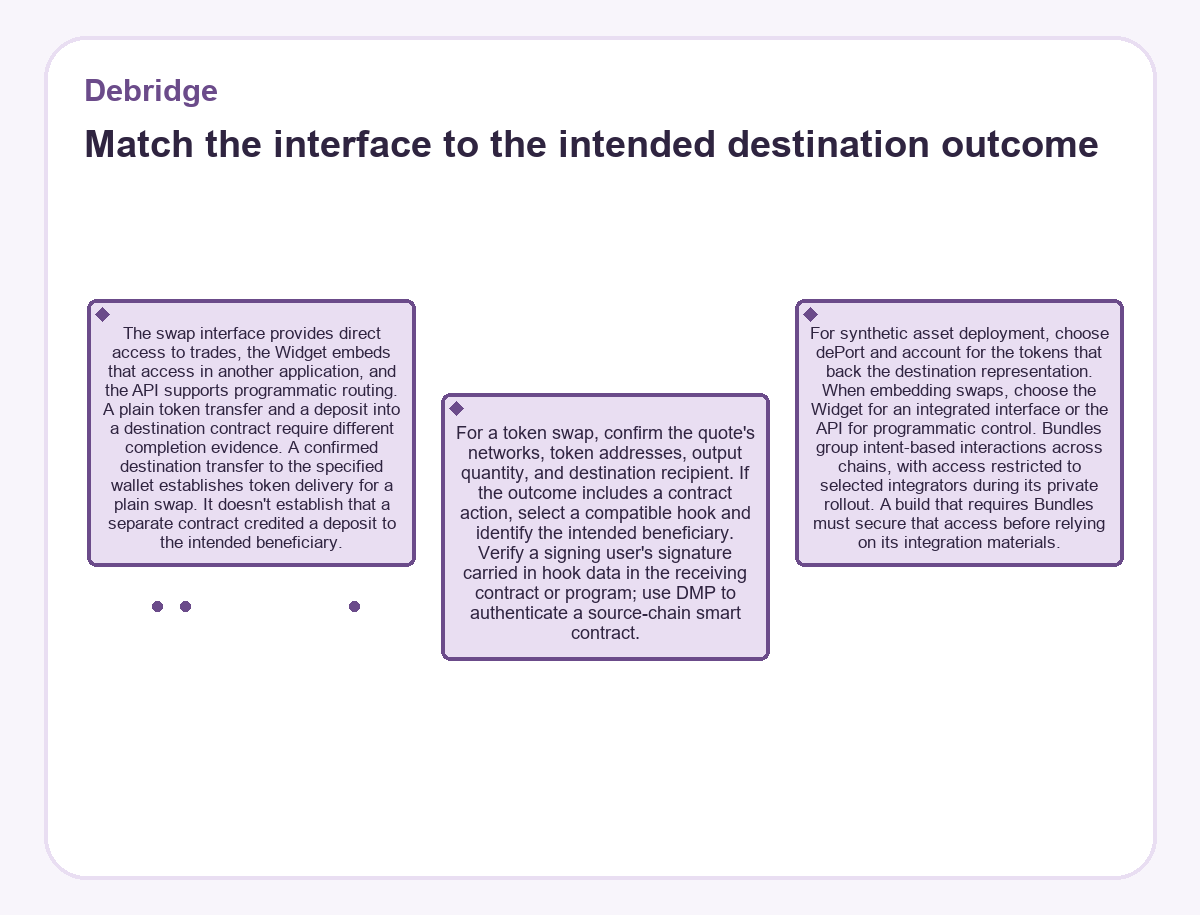
Match the interface to the intended destination outcome
The swap interface provides direct access to trades, the Widget embeds that access in another application, and the API supports programmatic routing. A plain token transfer and a deposit into a destination contract require different completion evidence. A confirmed destination transfer to the specified wallet establishes token delivery for a plain swap. It doesn't establish that a separate contract credited a deposit to the intended beneficiary.
- For a token swap, confirm the quote's networks, token addresses, output quantity, and destination recipient.
- If the outcome includes a contract action, select a compatible hook and identify the intended beneficiary.
- Verify a signing user's signature carried in hook data in the receiving contract or program; use DMP to authenticate a source-chain smart contract.
- For synthetic asset deployment, choose dePort and account for the tokens that back the destination representation.
- When embedding swaps, choose the Widget for an integrated interface or the API for programmatic control.
Bundles group intent-based interactions across chains, with access restricted to selected integrators during its private rollout. A build that requires Bundles must secure that access before relying on its integration materials.
Debridge: what people ask
Which response field identifies a cancellation's refund asset?
The srcChainTokenOut field identifies the refund asset when order placement converted the original input into a reserve asset. If that field is absent, the relevant asset appears in srcChainTokenIn. Token address, chain, and decimals distinguish the actual asset and its units. This is separate from dstChainTokenOut, which describes the requested destination output. A cancellation refund therefore needn't use the token originally supplied.
Is a token approval the same as creating a DLN order?
A token approval grants spending permission, while a successful source-chain order-creation call establishes a DLN order. An approval alone doesn't prove that a cross-chain trade exists or that destination fulfillment occurred. Where the input token requires an allowance, that allowance must cover the amount that the executable transaction will spend. Operating expenses added to the input can affect that amount; the interface's displayed swap amount isn't always the complete authorization requirement.
Does DLN fulfillment prove that an attached hook succeeded?
DLN fulfillment alone doesn't prove that an attached non-atomic hook completed successfully. Its output can remain in an intermediary contract while hook execution is pending. EVM hooks can require success or allow failure, depending on their configuration; optional-success failures use the configured fallback address. Solana supports non-atomic success-required hooks. The hook's execution result determines whether the intended destination action occurred, beyond the order's fulfillment status.
Can an IaaS chain support swaps without appearing in the main app?
An IaaS-connected chain can support swaps through the DLN API or an integrated Widget even when the main app doesn't list it. Main-app inclusion uses additional chain-evaluation criteria, including security and activity measures. Infrastructure support and visibility in a particular interface are separate decisions. An integrated interface can expose the supported chain, while individual token trades still require usable liquidity and a route that solvers can fulfill.
How long will a DLN transfer take?
DLN settlement time varies with source-chain confirmation, available solver liquidity, and the order's economics. The source transaction must create the order before a solver can fulfill it. Network load and changing market conditions affect that process. A displayed estimate isn't a universal arrival deadline. Cross-chain limit orders can remain unfilled while their specified terms fail to attract a solver.
When is a wallet connection needed for a same-chain swap?
A wallet connection isn't required to obtain an initial same-chain estimate. The executable transaction request adds wallet and recipient information, allowing the API to construct the transaction for the intended accounts. After any required token approval, the wallet signs the transaction, which must then be submitted to the network for execution. An estimate obtained earlier grants no spending permission, and changing market conditions can require a refreshed quote before signing.